
The afternoon sun slanted through the tall front windows of Bardo Coffee on South Broadway, painting the worn wooden floors in long, honeyed stripes. David Harrington had claimed his usual corner table by the brick wall, the one where the light hit just right for reading without glare. At sixty, he still moved with the easy confidence of a man who had kept himself in shape—broad shoulders from decades of weekend hikes in the Front Range, silver-threaded hair that he wore a little longer than fashion dictated, and a quiet smile that had aged well. He sipped his flat white, flipping through a dog-eared copy of *The Remains of the Day*, content in the gentle hum of the café.
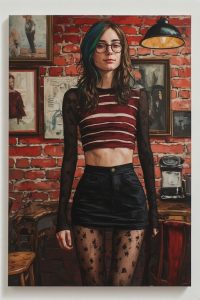
Then she walked in.
She was slender as a willow, maybe thirty, with the kind of effortless grace that made the room feel suddenly smaller. A sheer black coverlet draped loosely over a tight, cropped burgundy top that clung to the soft curve of her waist, the fabric catching the light like spilled wine. Her short black skirt skimmed her thighs, and beneath it, patterned stockings—delicate black lace woven with tiny crimson threads—drew the eye downward to ankle boots that clicked softly on the floor. Her dark hair fell in loose waves past her shoulders, and when she turned her head to scan the menu board, the afternoon light caught the elegant line of her jaw, the faint shimmer of gloss on her lips.
David forgot his book entirely.
He wasn’t the type to stare; he never had been. But something about her—poised yet unselfconscious, as if the world had been waiting for her arrival—held him transfixed. She ordered a lavender oat-milk latte at the counter, her voice carrying just enough to reach him: warm, melodic, with a faint lilt that might have come from somewhere farther south. When the barista called her name—Elena—she thanked him with a smile that lit the whole corner of the café.
She glanced around for a seat. Every table was taken except the one beside David’s, the small two-top that regulars knew was unofficially communal. Their eyes met. She raised an eyebrow in silent question.
“Please,” he said, gesturing. “I don’t bite. And I promise the chair doesn’t either.”
Elena laughed—a bright, genuine sound that made the barista glance over with a grin—and slid into the seat across from him. “Dangerous offer. I’ve been known to talk strangers’ ears off.”
“I’ll risk it,” David replied, closing his book. “I’ve been reading the same page for twenty minutes anyway.”
They fell into conversation the way rain falls in Denver spring—sudden, easy, and impossible to ignore. She was an illustrator, she told him, freelancing out of a tiny studio in Baker. She’d moved to Colorado three years ago, chasing mountains and better light for her watercolors. David shared that he was a retired civil engineer who now consulted part-time on historic preservation projects around the city. “Old buildings and older men,” he said with a self-deprecating shrug. “We both appreciate a good foundation.”
Elena’s eyes sparkled. “And here I thought engineers were all pocket protectors and spreadsheets.”
“Only on Tuesdays. Wednesdays, I’m brooding and poetic.”

She laughed again, and the sound wrapped around him like warm silk. They talked about everything and nothing: the way Broadway changed after dark, the best hidden trails in Washington Park, her latest series of paintings inspired by the city’s alley murals. She had a wit that danced—sharp enough to tease, gentle enough to invite. When he mentioned his failed attempt at sourdough during lockdown, she leaned in, chin on her hand, and said, “Let me guess. You treated it like a construction project. Precise measurements, no room for chaos.”
“Guilty,” he admitted, grinning. “It rose like a brick.”
Her laughter filled the space between them. David felt something he hadn’t in years: the simple, electric pleasure of being seen. Not as the older guy at the coffee shop, but as a man whose stories still mattered. He noticed the subtle things—the way her fingers traced the rim of her cup when she listened, the soft confidence in her posture. And yes, after a while, he noticed something else. The delicate angle of her throat, the faint trace of stubble beneath expertly applied makeup, the way her voice carried just a shade deeper than expected. She was likely a transgender woman. The realization settled in him gently, without fanfare. It changed nothing. She was exquisite—every line, every gesture, every spark of humor. Nothing short of enchanting.
Time slipped away. The café’s afternoon crowd thinned; the baristas began wiping down the espresso machine. David felt the conversation blooming into something brighter, warmer. Her knee brushed his under the table once, accidental and electric. She didn’t pull away immediately. He gathered his courage—the kind that comes from knowing you might never get another moment like this—and leaned forward.
“Elena, this has been… far better than my book. Would you let me buy you a proper cocktail somewhere? Maybe dinner after? There’s a little Italian place two blocks up that does a carbonara worth writing home about. No pressure. Just… I’d like to keep talking.”
He said it lightly, honestly, his eyes steady on hers. No games. Just the truth of a man who had been moved.
For a heartbeat, her smile held. Then something flickered—surprise, hesitation, a soft shadow crossing her features. She set her cup down with deliberate care, the patterned stockings shifting as she crossed her legs. Her body language had been generous all afternoon: open shoulders, easy laughter, the kind of warmth that made strangers feel like friends. Now it gentled further, almost protective.
“David,” she said, her voice low and kind, “you’re lovely. Truly. This conversation… it’s been a gift. You make me laugh in a way most people don’t bother trying anymore.” She paused, choosing her words like she chose colors for her paintings—precise, honest. “But I’m looking for something different right now. Someone closer to my own age. A younger lover, I suppose. It feels strange even saying it out loud, because you’ve been nothing but wonderful. I don’t want to hurt your feelings. God, that’s the last thing I want. You’re handsome, and sharp, and the kind of man who listens like it matters. But I… I’m seeking someone who’s in the same chapter of life I am.”
She met his gaze without flinching, her dark eyes soft with regret and sincerity.
David felt the words land—not like a blow, but like a quiet door closing on a beautiful room he’d only glimpsed. A small ache bloomed in his chest, the kind that comes from wanting what you know isn’t yours to keep. But beneath it, something steadier: respect. For her courage in saying it plainly. For the grace she offered him in the saying.
He nodded slowly, a gentle smile curving his lips. “Elena, thank you. For the honesty, and for the afternoon. You’re right, of course. You’re young, brilliant, and far too radiant for an old engineer who still thinks carbonara is the height of romance.” He chuckled softly, the sound warm and without bitterness. “I’m honored you sat down. Truly. And I’m even more honored that you told me straight. That’s rarer than you know.”
He reached across the table—not to touch her hand, but to lift his empty cup in a small toast. “To chance encounters that remind us the world’s still full of wonder. And to you—may your next painting be your best yet, and your next conversation even better than this one.”
Elena’s shoulders relaxed. The tension that had crept into her posture melted away, replaced by something like relief and fondness. “You’re a good man, David Harrington. The kind they write about in those books you read.”
They stood together. She gathered her sketchbook from the chair beside her; he slipped his novel into the worn leather satchel he’d carried for fifteen years. Outside on South Broadway, the spring air carried the faint scent of rain on pavement and distant lilacs. They paused on the sidewalk, the late-afternoon light gilding the brick storefronts.
“Take care of yourself,” she said, and for a moment her fingers brushed his forearm—light, friendly, final.
“You too,” he replied. “And if you ever paint that alley mural you mentioned—the one with the hidden fox—send me a photo. I’d like to see it.”
She smiled, the kind that reached her eyes. “I will.”
Then she turned, skirt swaying, patterned stockings catching the last of the sun, and walked north toward the glow of the city. David watched her go until the crowd swallowed her silhouette. He stood there a long moment, hands in his pockets, feeling the gentle ache settle into something warmer: gratitude.
He didn’t feel foolish. He felt lucky. Sixty years on this earth, and still capable of being enchanted by a stranger in a coffee shop. Still capable of recognizing beauty—not just the curve of a waist or the shimmer of stockings, but the sharper, rarer kind: wit that sparkled, honesty that didn’t flinch, a soul that knew what it wanted and offered kindness in the refusal.
David turned south, toward his car parked near the old theater. The memory of her laughter rode with him like a secret. He would carry it home, tuck it beside the dog-eared novel and the half-finished trail maps on his desk. It was enough. More than enough. In a world that often rushed past such moments, he had been given one perfect afternoon—one where an older man had been reminded that desire could be quiet, respectful, and still profoundly alive.
And that, he thought as the Denver sky turned the color of her burgundy top, was a story worth keeping.